
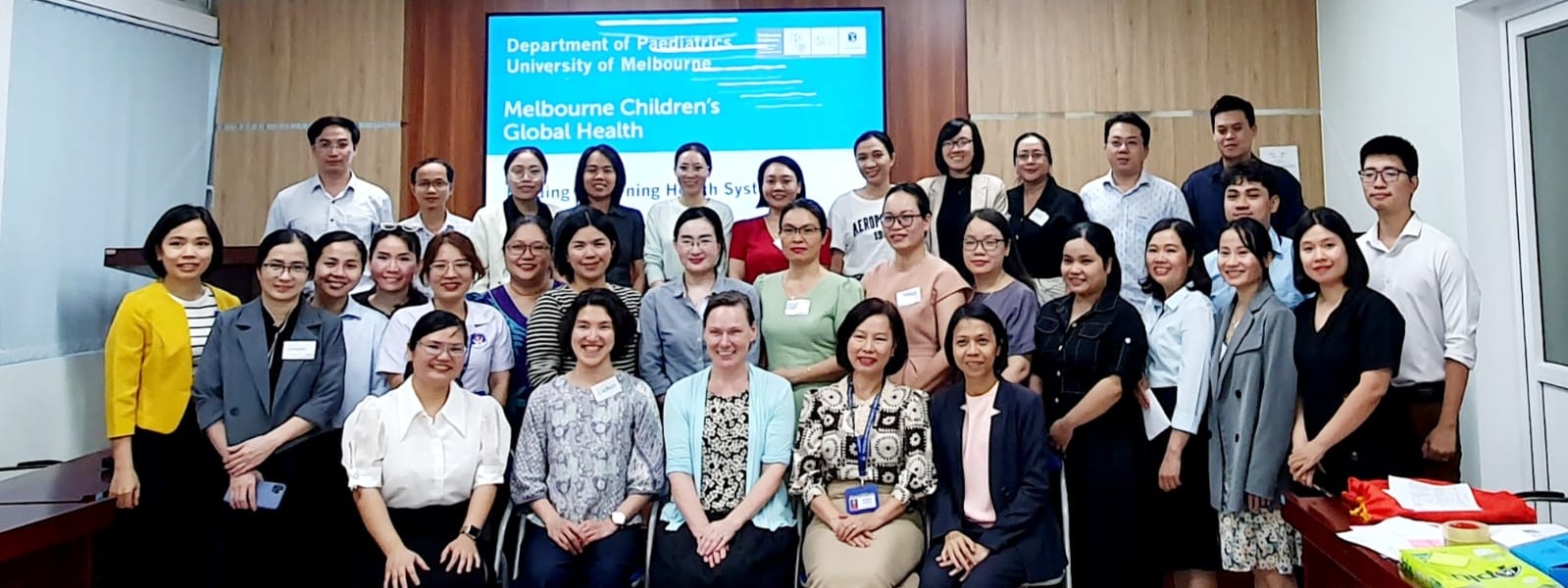
Leading a Learning Health System Course at Da Nang University of Medical Technology and Pharmacy
The Department of Paediatrics University of Melbourne and Melbourne Children's Global Health are pleased to share the successful delivery of the Leading a Learning Health System (LLHS) course for clinicians and educators at Da Nang University of Medical Technology and Pharmacy.
Designed to build leadership capabilities and the practical application of Learning Health System (LHS) principles, this course engaged participants through interactive sessions on leadership development, continuous learning, and quality improvement.
This program was made possible with the invaluable support of our local collaborators:
- Dr. Thủy Cao Bích, Dean of Da Nang University of Medical Technology and Pharmacy
- Dr. Chau Le, Vice Head of Obstetrics & Gynecology and Pediatrics Department, Da Nang University of Medical Technology and Pharmacy
- A/Prof Hoang Thi Tran, Deputy Director of Da Nang Hospital for Women and Children
- Dr. Le Thi Huynh, Head of Neonatal Unit, Da Nang Hospital for Women and Children
Evaluation data indicated that all participants found the course valuable, with 72% rating it as highly valuable, 28% rating as valuable.
Qualitative feedback highlighted the key takeaways for participants, who described meaningful changes they plan to make in their approach to leadership, learning, and system improvement:
Leadership
Participants expressed a commitment to fostering safer, more supportive team environments:
- "A good leader builds a well-rounded team, create a safe environment so that they can develop their best abilities.”"
- "Conflicts are opportunities for growth and improvement in the team."
Learning
Participants emphasised plans to enhance their feedback approach and refine coaching methods:
- “Learning to observe, listen, and give feedback in a way that is tailored to the individual.”
- “A coach is someone who listens and advises, not someone who makes decisions.”
Systems Learning
Many gained a structured approach to problem-solving, particularly through the Plan-Do-Study-Act (PDSA) cycle:
- “In the past, I would just look at the problem, try to find the cause, and fix it without any structure. Now I can see existing issues in the hospital and apply the PDSA cycle to improve them.”
These valuable insights and skills reflect the power of collaboration and the program’s impact on supporting leadership in healthcare across the Asia-Pacific.
We look forward to continuing our partnership with the team in Da Nang, who are taking the lead locally to reinforce and expand on the LLHS principles.


